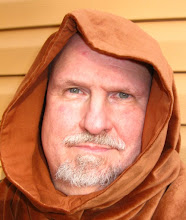
The Spanish bullfighter Juan José Padilla, who lost an eye when a bull gored him in the face, is preparing to enter the bullring again, with a pirate's eyepatch over one eye.
You can click the link to see photos of Padilla pre- and post-goring - - significant surgery took place, and his post-goring photos have left him gaping like a cretin - - and even see the horrible footage of the goring itself.
However, Padilla won't be the first one-eyed bullfighter. James Michener, in his monumental tribute to Spain, Iberia, wrote of another matador who lost an eye to a bull:
On June 1, 1857, the Concha bull Barrabás participated in what the books describe as 'one of the most famous accidents in the history of bullfighting' in that, with a deft horn, it caught the full matador Miguel Domínguez under the chin and then in the right eye, gouging it out. It was assumed that Domínguez would die, for his face was laid open, but with a valor that had characterized his performance in the ring he survived, and three months later was fighting again as Spain's only one-eyed matador, having stipulated that for his return the bulls must again be from Concha y Sierra. For another seventeen years he fought with only one eye and enjoyed some of his best afternoons with Concha bulls. He is known in taurine history as Desperdicios (Cast-Off Scraps, from the contemptuous manner in which he tossed aside his gouged-out eyeball).
An aspect of bullfighting etiquette is that, when a bull breaks off a horn in the ring, a matador may only pass the bull (allow to charge past) on the side with the remaining horn. I wonder if there is an etiquette established for passing the bull when the matador only has one eye?
Showing posts with label bullfighting. Show all posts
Showing posts with label bullfighting. Show all posts
Friday, March 02, 2012


Tuesday, August 02, 2011
Spain To Protect Bullfighting On "Artistic" Grounds
Not so ridiculous as it might at first sound.
James Michener in his definitive book on Spain, Iberia, mentioned this linkage of bullfighting to art. In Spain, bullfighters aren't compared with sports figures, but with artists. Bulls were painted on the walls in the Altamira Caverns; Goya painted bullfight scenes, as did Picasso. American matador John Fulton, who lived in Seville during the time I was there (1980's) made part of his living painting bullfight scenes in bull's blood.
Bullfighting becomes more of an anachronism each year, and eventually it will be banned. But not yet, not in Spain.
Tuesday, June 15, 2010
Saturday, May 22, 2010
One Horrific Goring
Spanish matador Julio Aparicio was gored in the Las Ventas bullring in a horrible fashion.
If you want to see the horrible sight, it's under the cut. You can also find video with a Google Search.
If you want to see the horrible sight, it's under the cut. You can also find video with a Google Search.
Thursday, October 01, 2009

Thursday, May 28, 2009
The Bull's Dying...
...and the matador ain't feeling too well, either.

Scenes like this happen every year in bullfighting countries. Say what you like about the sport, that it is bloodthirsty, cruel and butchery; the fact remains that it takes a great deal of courage to step into the ring to face a bull bred solely for fighting. Look at this particular bull: his horns haven't been cut short or blunted, they are sharp and deadly. The bull isn't too heavy, he's trim and muscular and strong. This one has gone through the entire process of the fight: his shoulder muscles jabbed by the spear of the picador, tired by running after swift bandarilleros who leave barbed darts in his shoulders to weaken his shoulders further, forcing him to lower his head for the thrust of the killing sword, the espada, which can be seen jutting between the shoulders, the blade reaching down to the heart itself. Even with the deadly steel in his vitals the bull was able to raise his head in a thrust that caught the unwary matador in the chest, probably the moment after the sword went in; it's a vulnerable moment for the matador, and this man, Israel Lancho, paid the price for his lapse.
update: It's on YouTube:
Pretty grim footage. Since Lancho was suspended on the horn for at least 3 seconds, you can see that there was more than one damage vector from the horn inside his body. I should note for those unfamiliar with bullfighting that there is usually a fully-staffed emergency facility at each bullring, and an ambulance standing by to handle just this sort of situation. It doesn't guarantee that a bullfighter's life will be saved, but it increases his chances.
Monday, January 26, 2009
The Baby Bullfighter
Michelito Lagravere Peniche, 11 years old, is the son of a bullfighter and a bullfighter himself. He just killed 6 bull calves in Merida, Mexico, to prove it.
Pic:

Starting out this young he has the potential for a very long career, with the possibility of that career ending at any time. Bullfighters still die in the ring; during the time I lived in Spain, two full matadors, Paquirri and El Yiyo, were both gored to death by bulls.
Pic:

Starting out this young he has the potential for a very long career, with the possibility of that career ending at any time. Bullfighters still die in the ring; during the time I lived in Spain, two full matadors, Paquirri and El Yiyo, were both gored to death by bulls.
Tuesday, November 11, 2008
Bullfighting And Firebombs
Bullfighting in Spain is often venal and corrupt, but you don't often hear of mafia-style struggles for domination of the art.
In a Toledo, Spain, courtroom, evidence is being heard that the followers of one bullfighter, Jose Miguel Callejon Martin, hired Columbian criminals to firebomb the horses of a rival, Sergio Galan. By mistake the Columbians targeted the horses of another bullfighting clan, the Domecqs of Spain's Sherry capital, Jerez de la Frontera. Six horses died, another 6 took years to recover from their injuries. The Domecqs are seeking redress for their losses.
I've seen the Domecq horses personally, when I lived in Spain in the mid-'80's. Not only do the Domecqs make money from Sherry and Brandy, they also have bullfighters in the family, play polo, and run a Spanish Riding School that features Cartujano horses, known in Austria as Lippizans.
Here's Luis Domecq in the bullring:

Subscribe to:
Posts (Atom)